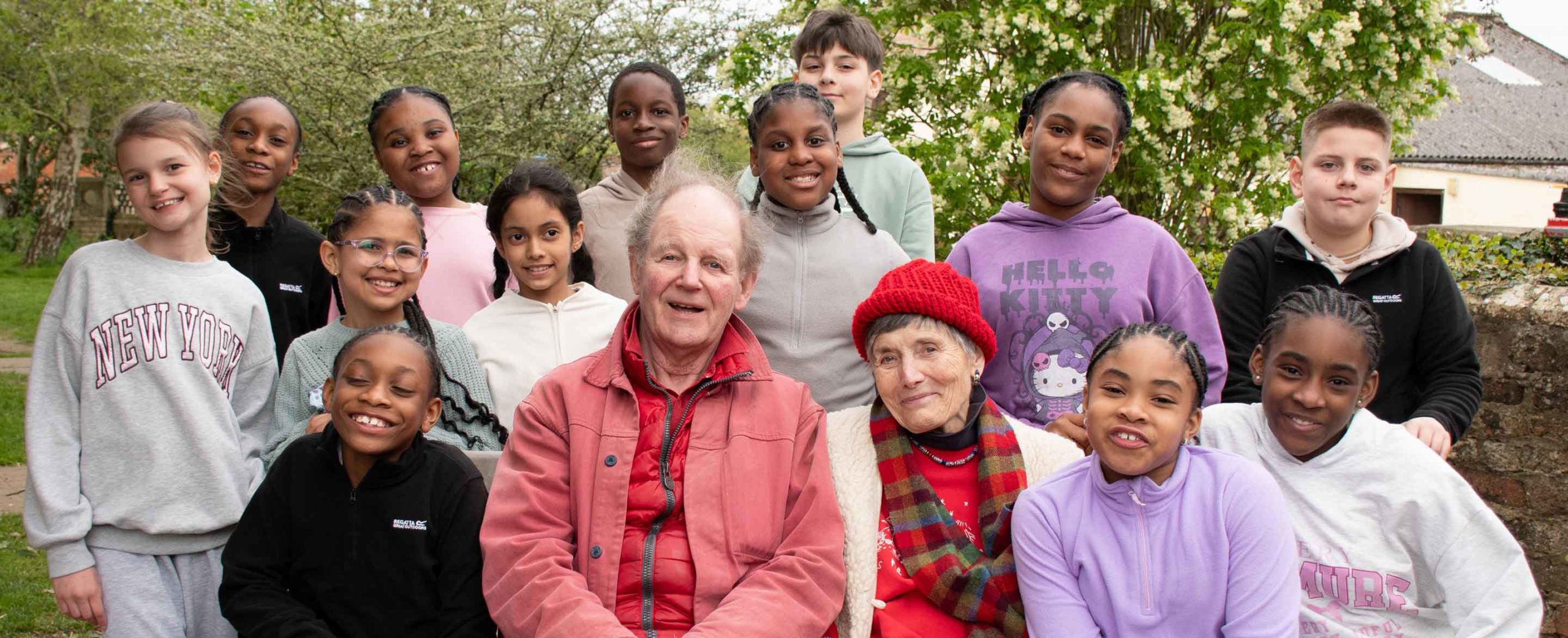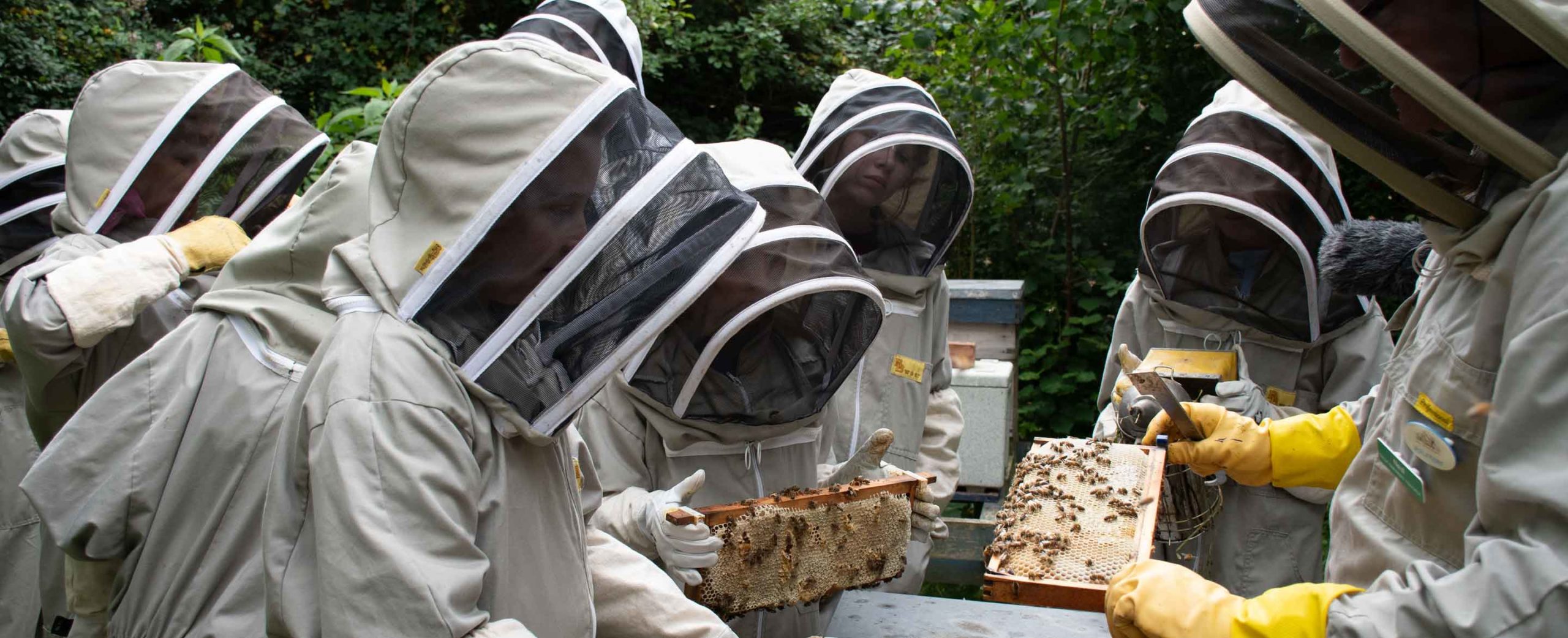
Our farms are supported by a wonderful group of volunteers who generously give their time, knowledge and skills. Often week after week and year after year. They work alongside our staff with everything from craft and cookery sessions to nurturing the gardens and help our bees flourish. They are vital to the fabric of our farms and we are grateful to each and every one of them.
In this 50 voices story we hear from three volunteers, each with different skills and reasons to volunteer. their stories share common themes and reveal how much our volunteers gain from giving their time.
A feeling of community
One crisp Monday in late October, a group of people are sharing a much-needed cuppa, catching up on the jobs for the day and sharing their news. It could be a moment in a cafe in nearby Hatherleigh, but the wellies, waterproofs and trays of apples give away the real location: the potting shed in the walled garden at Nethercott House. The group of people are just some of the dozen or so volunteers who come weekly to help out on the farm.
Flick has been volunteering for nearly four years and approached the team at Nethercott soon after she retired and moved to mid Devon. She smiles as she explains that her reasons for getting in touch were not all altruistic. “Oh, it was partly selfish, I wanted to learn from Janette the head gardener as I wanted to become more self-sufficient.” She continues: “What better way to learn how to garden in a low-impact way than in a restored Victorian walled garden?”
Flick has a background rooted in education and philosophy. She says that she thinks that a week on the farm is “Such an amazing place for kids” as she explains. “Before I came to volunteer here, I felt that often in school settings children don’t get the experiences they need, it isn’t rounded and experiential, everything is so squeezed.”
Time for tea
As the tea break ends Flick looks at the whiteboard and her tasks for the day, she is clearing the cold frames ready for cauliflower seedlings, but first she grabs a wheelbarrow and heads off into one of the fields to shovel up a barrow of manure.
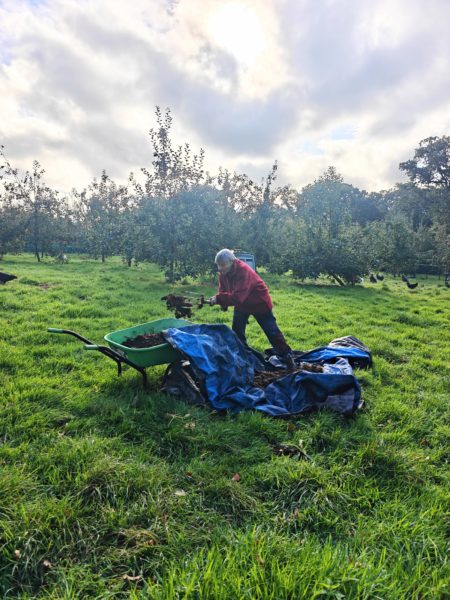
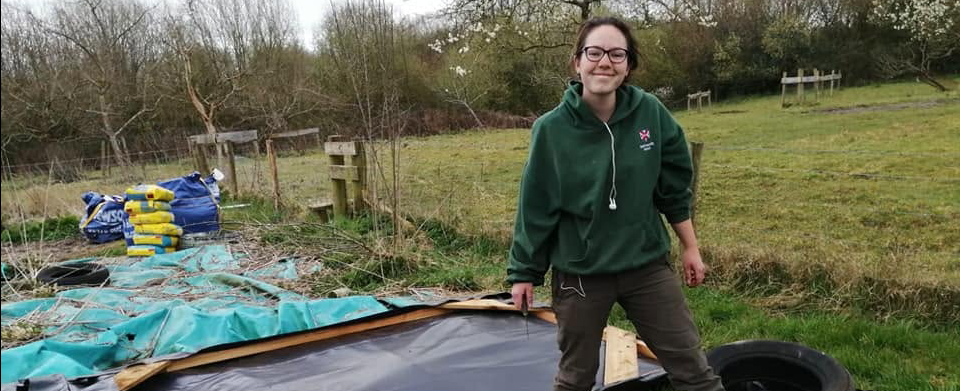
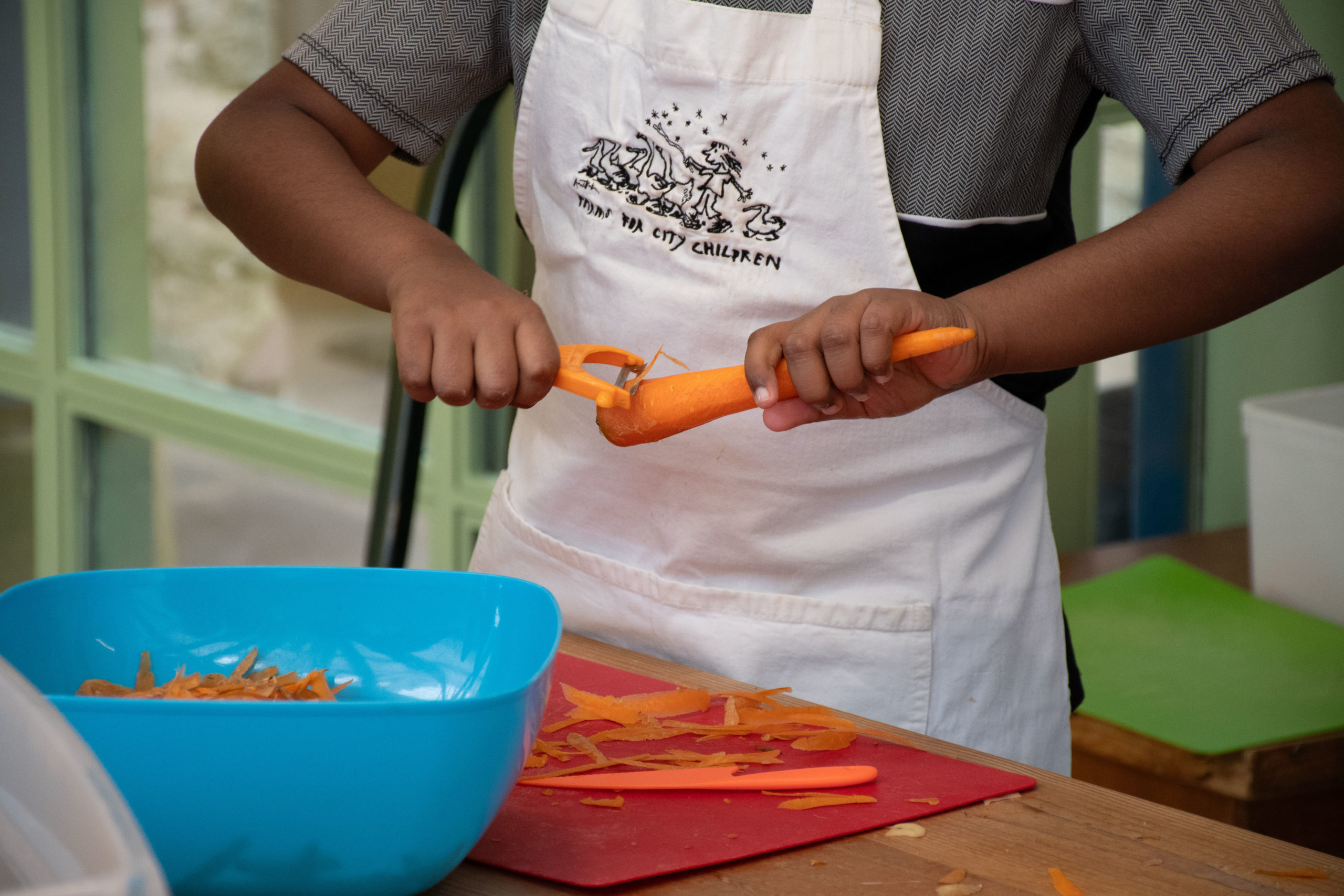
Once her barrow is full, she deftly manoeuvres it to the cold frame to begin work. Once a layer has been added she jumps in the frame and begins to transplant the seedlings, sown by a school group weeks previously. “This is what I love, she comments. I know that the seeds and plants I help to grow will go on to be in the kitchen I can see across the yard and then onto the children’s plates.” She continues, “As volunteer on a Monday the children are just arriving for the week, so I don’t often see them in the garden but I know they will eat the carrots I pulled up this morning and that carrot will taste like no carrot they have eaten before.”
Asked what she gets from her weekly volunteering sessions Flick says it is a two-way thing. “I feel the farm is transformative for the children who come but I also come away each week having learned something. I have sown onions from seed for the first time at home, I learned just how vital watering is and as someone who finds lots of social situations tricky, I find my time here at Nethercott an escape and my fellow volunteers are so kind – we are a little team within a bigger team and I look forward to every Monday”.
While Flick finishes planting the cauliflowers, across the walled garden just past the apple arches Karl, another volunteer is harvesting the last of the potatoes.
The power of soil
A research scientist and Professor Emeritus of Soil Ecology at the University of Nottingham, Karl has spent 46 years working in his field and remains active today, through public outreach, scientific editing, to work at policy level.
For Karl, volunteering at Nethercott brings together several things that have mattered throughout his career: science, education and the opportunity to get outside and put both into practice.
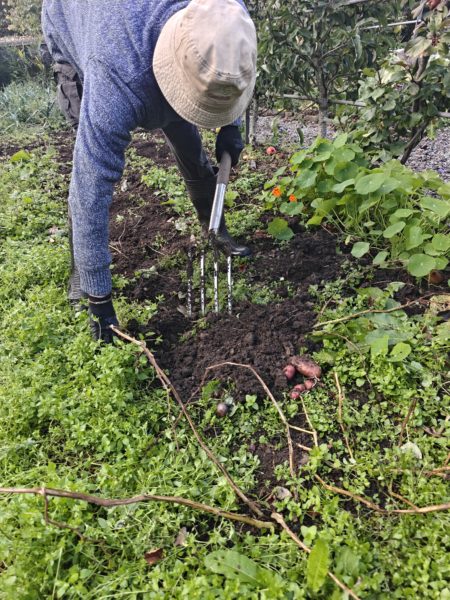
“In my retirement, this is the ideal charity for me to support,” he says. “It is a special way to start my week and meet people. My time at the farm is social, with like-minded people, and relaxing. It is a genuinely wonderful place to be involved.”
Unsurprisingly for a scientist, Karl notices what is happening beneath his feet as much as what is growing above ground. He describes Nethercott’s 150-year-old walled garden as having “some of the best soils I’ve seen”. The result of generations of care, appropriate management and, he adds, “the magic of manure”.
What is hidden beneath
That healthy soil is something he can make tangible for the children too. On one occasion, counting worms spade by spade, Karl explained that healthy productive soil contains at least 16 worms in a volume about size of a biscuit tin. Karl also brings samples to events, for children to examine under a microscope. Helping them see a world that might otherwise remain hidden beneath their feet.
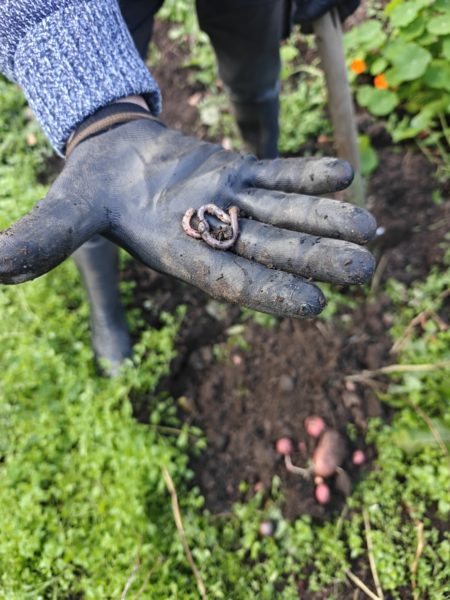
It is this chance to see, do and discover for themselves that Karl believes makes a week at Farms for City Children so effective.
“Children inherently pick things up when they see and do. That is what is so special,” he says. “They are immersed in how we produce food for the week and they learn quickly and deeply.”
The learning goes both ways. Karl might bring decades of scientific knowledge to Nethercott, but he is still observing and learning from the garden himself, including seeing first-hand how rapidly changing weather patterns affect what can be grown and when. And, like Flick, the people are an important part of what keeps him coming back each Monday.
For him, the volunteers have become a “community within the community”, sharing knowledge, conversation and the jobs that need doing, while helping to care for a place where children can experience science, food and farming for themselves.
Buzzing about bees
Over at Wick Court Ted is one of the volunteers who care for the bee hives onsite. Ted retired 10 years ago from a career in the probation service, initially he volunteered for the Nelson Trust, a drug and alcohol charity. He felt he needed a different outlet and a chance conversation with his wife Olga got him thinking. She commented that they are always purchasing honey locally or from their travels, so why didn’t Ted look into bee keeping.
That led Ted to Stroud Bee Keepers and the much-missed Pat, who not only trained the Stroud Bee Keepers but initially set up the hives at Wick Court. As Ted recalls “It fitted me perfectly, much like the bee suit.”
Ted was one of the amazing volunteers who helped look after the Wick Court hives during lockdown, he has also encouraged other local beekeepers including Neal, to support activities at Wick Court. Over time Ted has given staff on-site training meaning the bees have amazing care all-year-round.
Ted joins other volunteers at Wick regularly, not only tending the hives but giving the young farmers hands on experiences. As Ted comments: “It is such a wonderful and fulfilling experience, to see children initially frightened, peeping through their bee suits. They might be reluctant to come near the hives, but I take them the frame, and they are transfixed by what they see.”
A special connection
Ted further comments that he notices a special connection between the children and bees and that it gives him hope for the future. As he says: “A week here is more important than ever, I truly believe the children go home with a connection to the planet they live on and a sense of belonging.”
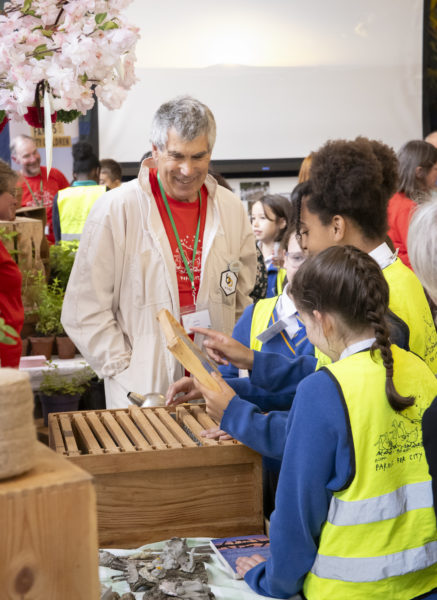
When asked about why he volunteers Ted comments that “There is nothing more fulfilling than seeing a child scamper around the fields in a boiler suit, not afraid to get muddy, to splosh a puddle.” He continues: “I feel totally ‘at home’ at Wick Court, everyone is there because they want to be.”
You can help more young people to grow their knowledge through hands-on learning, by tasting freshly-pulled carrots or witnessing the wonder of a beehive. Find out more about how you can Support us.